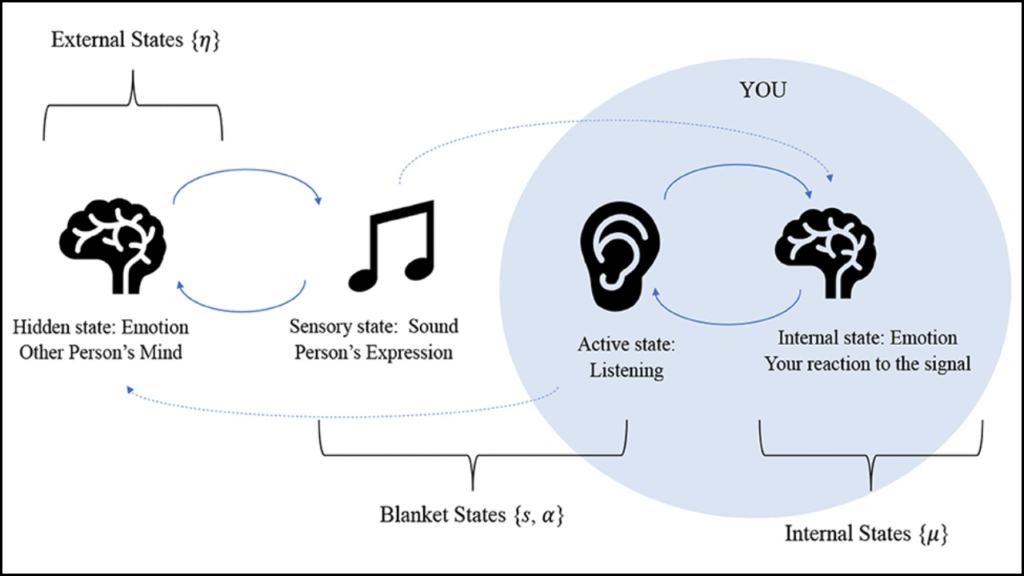
Emotions form the invisible thread that connects people through love, empathy, and shared understanding. Yet, emotional experiences are highly dynamic and uncertain, making them difficult to capture using traditional research methods. Bayesian modeling provides a powerful framework to study emotional dynamics by incorporating uncertainty, individual differences, and evolving emotional states over time. Dr. Saida Heshmati’s Main Lab employs Bayesian approaches to uncover how emotions fluctuate within and across relationships, allowing for richer, more adaptive interpretations of human behavior. This analytical method enables researchers to explore the complexity of emotional experiences through data-driven, probabilistic reasoning.
Table of Contents
Understanding Bayesian Modeling
Bayesian modeling is a statistical approach based on probability and belief updating.
It allows researchers to combine prior knowledge with new data to improve prediction accuracy.
Emotional dynamics are modeled as systems that evolve rather than static variables.
The Bayesian framework can handle uncertainty, missing data, and individual variability efficiently.
Dr. Heshmati’s Lab utilizes these models to study how love, empathy, and stress change in response to interpersonal and cultural contexts.
Why Bayesian Models Are Suitable for Emotional Research
Emotions are non-linear and context-dependent, making traditional linear models insufficient.
Bayesian modeling accounts for fluctuations and uncertainty inherent in emotional states.
It provides personalized predictions for each individual rather than general averages.
Bayesian inference updates continuously as new emotional data becomes available.
Dr. Heshmati’s Main Lab applies this adaptability to explore moment-to-moment emotional transitions in relationships.
Core Components of Bayesian Emotional Modeling
Prior Distribution: Represents existing knowledge or assumptions about emotional variables.
Likelihood Function: Describes how observed data relates to emotional hypotheses.
Posterior Distribution: Combines priors and data to produce updated emotional insights.
Hierarchical Structures: Model individual and cultural differences within collective emotional patterns.
Time-Varying Parameters: Capture emotional change dynamically across situations and interactions.
Bayesian Modeling Framework in Emotional Dynamics
Component
Definition
Application in Emotional Research
Prior
Initial belief before new data
Reflects baseline emotional tendencies
Likelihood
Data-based evidence
Measures emotion-behavior relationships
Posterior
Updated belief after observation
Represents refined emotional understanding
Hierarchical Levels
Multi-level structure of data
Differentiates individual and group effects
Dynamic Parameters
Time-dependent factors
Models emotional change across contexts
Bayesian Modeling in Relationship Studies
Relationships evolve through emotional exchanges that vary in intensity and frequency.
Bayesian methods model these interactions as evolving networks of affective states.
Dr. Heshmati’s research uses Bayesian dynamic models to track emotional trajectories in couples and families.
This allows for a precise understanding of how emotional responses predict satisfaction, trust, or conflict.
Models help distinguish stable emotional patterns from temporary fluctuations.
Advantages of Bayesian Emotional Modeling
Flexibility in integrating multiple data types—self-reports, physiological measures, and behavioral cues.
Enhanced interpretability through credible intervals instead of fixed-point estimates.
Capacity to model non-linear emotional dynamics, such as rapid emotional shifts or delayed responses.
Ability to adapt models as new data emerges, improving predictive accuracy.
Dr. Heshmati’s Main Lab utilizes this advantage for real-time emotional forecasting in relationship contexts.
Benefits of Bayesian Approaches in Emotional Research
Benefit
Description
Example in Dr. Heshmati’s Lab
Adaptivity
Continuous updating with new emotional data
Daily tracking of relationship moods
Individualization
Accounts for personal differences
Custom emotional models per participant
Uncertainty Quantification
Measures confidence in predictions
Estimating variability in affection levels
Integration of Diverse Data
Merges physiological and psychological data
Combining heart rate and self-report data
Dynamic Forecasting
Predicts future emotional trends
Anticipating stress and recovery cycles
Cultural Variations in Bayesian Emotional Models
Emotions are influenced by cultural beliefs and social expectations.
Bayesian frameworks allow researchers to compare emotional patterns across cultural contexts.
Priors can be customized to represent cultural norms around love, anger, or empathy.
Cross-cultural emotional modeling reveals universal and culture-specific emotional regulations.
Dr. Heshmati’s Lab employs Bayesian comparisons across global samples to study emotional synchronization within relationships.
Applications in Dr. Saida Heshmati’s Main Lab
Romantic Relationship Dynamics: Modeling daily affect changes between partners.
Cross-Cultural Emotion Studies: Comparing emotional regulation strategies across societies.
Social Network Emotional Influence: Understanding how one person’s mood affects group emotions.
Well-Being Prediction Models: Forecasting emotional recovery and resilience patterns.
Conflict and Resolution Analysis: Tracking emotional escalation and de-escalation over time.
Key Applications of Bayesian Modeling
Study Focus
Research Objective
Bayesian Contribution
Romantic Love Patterns
Analyze mutual emotional regulation
Identify cyclical affection and conflict
Friendship Dynamics
Explore empathy and support levels
Quantify emotional reciprocity
Cultural Adaptation
Compare emotional norms
Detect cultural moderation effects
Well-Being Prediction
Forecast emotional stability
Model recovery from stress episodes
Social Synchronization
Study group mood patterns
Measure shared emotional contagion
Computational Techniques and Tools Used in the Lab
Bayesian Hierarchical Modeling (BHM) for layered emotional data.
Markov Chain Monte Carlo (MCMC) for sampling from complex emotional distributions.
Stan and PyMC as programming tools for model estimation.
Dynamic Linear Models (DLM) for real-time emotional tracking.
Posterior Predictive Checks (PPC) for validating emotional models.
Dr. Heshmati’s Main Lab combines these tools to ensure statistical precision and emotional authenticity.
Challenges in Bayesian Emotional Research
High computational complexity for large emotional datasets.
Difficulty in selecting appropriate priors without cultural bias.
Need for interdisciplinary collaboration between statisticians and psychologists.
Requirement for transparent model reporting to ensure reproducibility.
The lab mitigates these issues through open-source modeling frameworks and training workshops.
Innovations by Dr. Saida Heshmati’s Main Lab
Creation of emotion-specific Bayesian templates for relationship research.
Integration of AI and Bayesian networks to automate emotional data interpretation.
Introduction of culturally adaptive priors to account for diverse emotional norms.
Collaboration with international labs to test models in multicultural environments.
Development of visual Bayesian dashboards for real-time emotion analysis.
Innovations Introduced by Dr. Heshmati’s Main Lab
Innovation
Purpose
Impact on Emotional Research
Emotion-Specific Bayesian Templates
Streamline emotional modeling
Faster and more reliable estimation
AI Integration
Automate data interpretation
Enhanced real-time emotional tracking
Cultural Priors
Include cultural emotion norms
Improved cross-cultural generalization
Collaborative Modeling
Share data across labs
Broader emotional dataset diversity
Visualization Tools
Interpret model outputs easily
Better understanding of emotional evolution
Ethical Considerations in Bayesian Emotional Studies
Protection of emotional data privacy is paramount.
Informed consent must include awareness of probabilistic modeling and continuous updating.
Transparency in how models interpret and use personal emotions is necessary.
Avoiding overgeneralization of emotional patterns across identities is crucial.
Dr. Heshmati’s Main Lab follows ethical guidelines for psychological and data-driven research integration.
In Summary
Bayesian modeling transforms emotional research by offering a nuanced, adaptive, and probabilistic approach to understanding human feeling. Through this framework, emotions are no longer treated as static snapshots but as evolving processes shaped by experience and culture. Dr. Saida Heshmati’s Main Lab pioneers this integration, combining psychology, data science, and cultural insight to reveal how emotional systems operate in real time. This approach not only deepens scientific understanding but also enriches the broader pursuit of love, empathy, and well-being across societies.
She is a creative and dedicated content writer who loves turning ideas into clear and engaging stories. She writes blog posts and articles that connect with readers. She ensures every piece of content is well-structured and easy to understand. Her writing helps our brand share useful information and build strong relationships with our audience.